
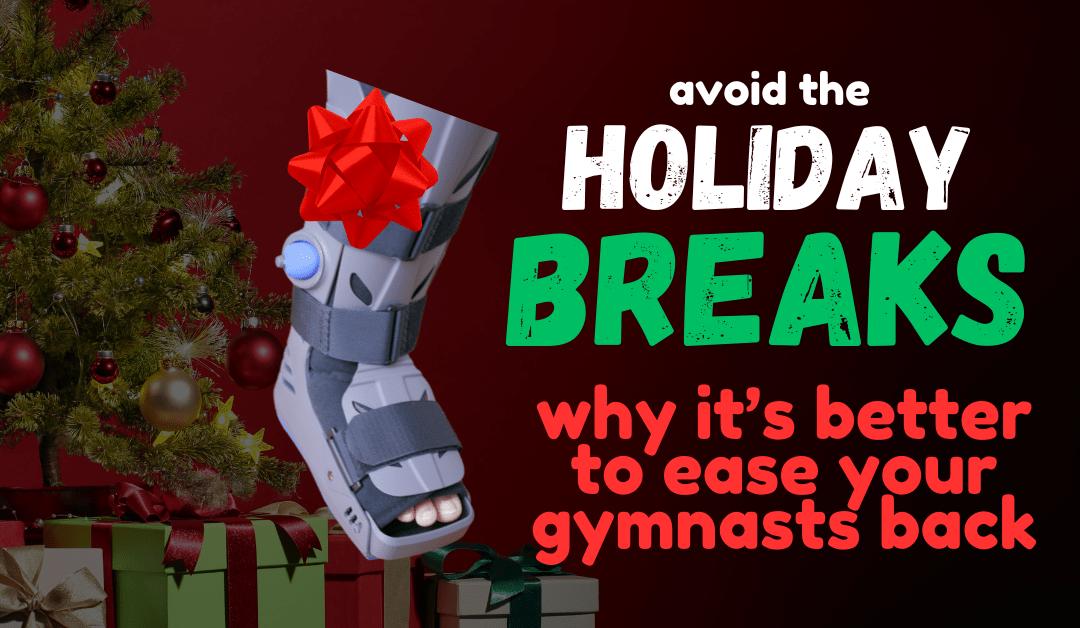
The return from holiday breaks looks different for gymnasts than most athletes.
Hannah Handstand is hyped up on sugar cookies and hasn’t even THOUGHT about pointing her toes in over a week.
Time to ramp up her practice to make up for lost time! I get where your coach’s head is at, but…this approach might not be accomplishing what they think.
Before your gymnast gets ready for her hardest workout EVER for January 2nd, let’s take a look at why I’m pushing the ease-in method.
Let’s look at the “regular people.”
We can all agree gymnasts aren’t “regular people.” They’re lovable weirdos who happen to be able to do some crazy things.
But since the specific stats on gymnasts are slim, let’s take a look at the “Muggles” to the gymnastics world.

In general, workload spikes can lead to injuries. Point. Blank.
But the body is an adaptive machine. If you provide it with gradual, planned, progressive change––it can do AMAZING things!
The same goes for REST.
If your gymnasts get a week or two over holiday breaks to adapt to REST, they need time to ramp back up again.
What injuries to look out for
When it comes to the most frequent injuries in gymnastics, the ankles and knees top the list.
- One, they’re taking on a TON of force at any given time.
- Two, they’re a major point of movement impairment––especially for gymnasts.
Let’s check in with another ✨fancy stat person✨ to get some context:
…up to 51% of injuries in gymnastics are in the lower body with very high proportions coming from the knee, ankle, and foot. There are two huge modifiable factors, strength & conditioning and teaching proper landing patterns, that are still not being utilized to their fullest potential in gymnastics.
– Dave Tilley (Shift Movement Science)
What was that last part?
Strength and conditioning? Good landing patterns?
Oh hey! That’s me! 🙋🏼♀️
Here’s the good news.
Two things we know for sure:
- Gymnasts are likely to get injured after holiday breaks.
- Their ankles are one of the most vulnerable parts.
So since we know the problems, we can actively prevent them!
How to prevent injury pre-break
Listen, I think kids get too much homework these days. But sometimes it’s a necessary evil.
Especially if your gymnast is already susceptible to ankle injuries, it might be in their best interests to put up a little pre-practice fight!
If you’re early to the show, I’m offering a Christmas Special before the holidays! Here are the deets:

Until Christmas Day, I’m offer an extra free month of coaching plus $1000 off of my 6-month injury prevention training.
Goal: keep them safe beyond that scary 1–2-week window when they return from break.
How to prevent injury POST-break
Now, instead of ramping up practice like a psycho (said with love ❤️), what do I recommend instead?
Well, lots of foam rolling, stretching, prehab, and visualization work, to start.
Now, that’s just for conditioning and warm-up––my specialties. I have less authority over your gymnast’s regular practice time, but here’s my two cents,
When my clients come back from time off, we review the basics. We fix positioning, revisit previous weaknesses, and try not to do anything too crazy dynamic, If everything checks out, we step up the intensity,
Basics, body tension work, drills, and frequent assessments will be your (and your gymnasts’) best friend.
How long do we keep this up for?
In my opinion, using the whole first week to recover is the minimum!
Check in where your gymnast is, mentally and physically.
Actually ask them, “Where are you at on a scale of 1–100%?”
If they start at 60%, that’s your baseline. From there, ramp up about 10% each week. Yes, that may take you 4 weeks to recover, but progressive training will always, always, ALWAYS give you a better long term result.
Plus, what does it matter if you get them back to 100% in a week-and-a-half, only to have them get injured a week later and be out for the rest of the season?
Just something to chew on 🤷🏼♀️
At any rate, Merry Christmas and happy holidays! And book here to see if you can still get that Christmas Special.
Best of luck in the new year!